Automated classification of volcanic earthquakes using Transformer encoders
Suzuki et al., Seismological Research Letters 97(2A), 1032–1047 DOI: 10.1785/0220240494
Volcanic earthquakes are classified into types — such as A-type events resembling ordinary earthquakes and B-type events dominated by low-frequency energy — and this classification provides key information for assessing volcanic activity. Traditionally it has depended on visual inspection by human experts, which is subjective and labor-intensive.
Using the diverse seismic activity of Mount Asama, we developed a deep-learning classification model based on a Transformer encoder. The model achieved F1 scores of 0.930–0.980 for the three classes (A-type, B-type, and noise), outperforming a convolutional-neural-network-based approach.
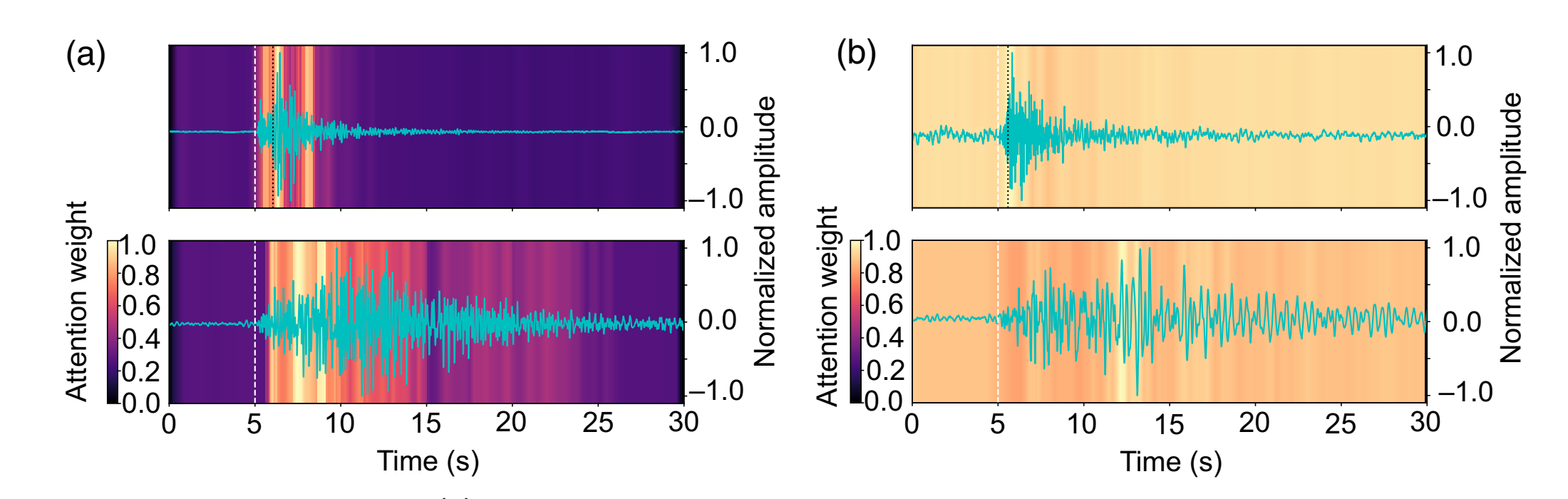
A distinctive contribution is interpretability: by visualizing the attention weights inside the model, we showed where in the waveform the "black box" focuses when making decisions. The model attends to key waveform features much like human experts do, while ambiguous labels in the training data were found to affect accuracy — highlighting the importance of data quality management. The framework can be transferred to other volcanoes, paving the way for enhanced volcanic hazard assessment.